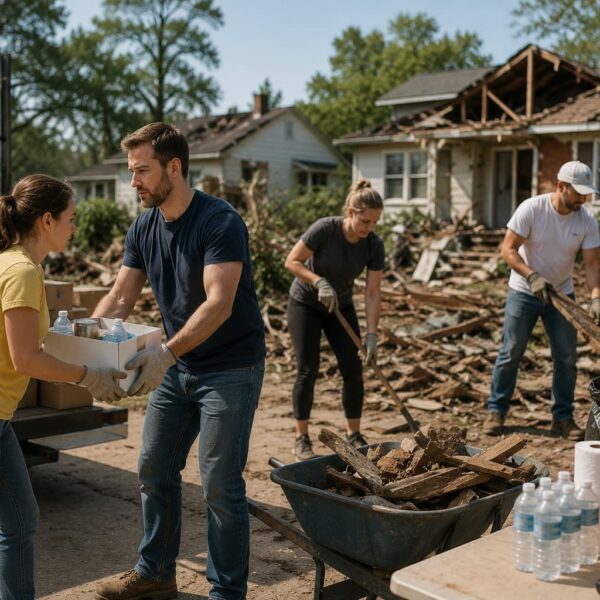
When a hurricane flattens a town, a flood swallows a neighborhood, or an earthquake reduces buildings to rubble, something remarkable and deeply human happens almost immediately: strangers pour in to help. Ordinary people load their trucks with water and supplies, drive toward the wreckage everyone else is fleeing, and start pulling neighbors from the debris with their bare hands. This surge of spontaneous compassion is one of the most moving features of any catastrophe. It is also, paradoxically, one of the hardest things for disaster professionals to manage, and whether it becomes a lifeline or a second problem comes down almost entirely to coordination.
The people at the heart of this are what emergency managers call spontaneous or unaffiliated volunteers, sometimes described as convergent or walk-in volunteers. They are individuals who show up to help or deploy themselves to a disaster zone without being part of any established relief organization. Their instinct is unquestionably noble, and their numbers can be enormous, providing a vital surge of manpower exactly when local responders are overwhelmed. But their very spontaneity creates a genuine dilemma. Because they arrive without preexisting relationships with response agencies, there is no easy way to verify their training or credentials, no record of who they are, and no simple mechanism for matching them to where they are actually needed. A crowd of willing hands with no structure can accidentally get in the way of the trained professionals doing search and rescue, put themselves in danger in an unstable environment, or duplicate efforts while genuine needs go unmet.
This is why the field has developed sophisticated systems to channel that goodwill rather than suppress it. The cornerstone in the United States is a network of organizations known as Voluntary Organizations Active in Disaster, or VOAD, which exists at national, state, and local levels. Their entire mission is to foster communication, cooperation, coordination, and collaboration among the many groups that respond to a catastrophe. The goal is to weave dozens of independent charities, faith-based groups, and community organizations into a single coherent effort that minimizes the duplication of services and ensures that the aid actually reaches survivors. When a volunteer affiliates with one of these vetted organizations rather than striking out alone, they are plugged into a structure that knows what is needed, where, and when.
On the ground, the machinery for absorbing a flood of untrained helpers has two key components. The first is the Volunteer Reception Center, which acts as a clearing house where spontaneous volunteers can register, be screened, and be matched to real tasks. Rather than a chaotic mob at the disaster site, arrivals are directed to this center, where their skills are recorded, their identities checked, and their energy pointed toward genuine gaps. The second is a Volunteer Coordination Team, often working from within the emergency operations center, which functions as the brain matching the supply of willing hands to the demand for specific work. A volunteer with medical training, a volunteer who can operate heavy equipment, and a volunteer who can only carry boxes are all valuable, but only if someone sorts them and sends them where they fit.
There is a parallel problem that every seasoned relief worker dreads, and it is one of the most important things an ordinary person can understand: the second disaster. When tragedy strikes, the public’s overwhelming instinct is to gather up used clothing, household goods, and food and ship them toward the affected area. It feels like the most natural act of kindness imaginable. Yet unsolicited physical donations frequently become a catastrophe layered on top of the original one. Mountains of mismatched clothes, random household items, and perishable food arrive at a scene that has no capacity to handle them. Receiving agencies are forced to divert precious staff, warehouse space, transport, and time away from helping survivors just to sort, store, and often dispose of things nobody can use. The generosity, tragically, clogs the very system meant to save lives.
This is why the near-universal advice from disaster professionals is as counterintuitive as it is important: give money, not goods. Cash donations to trusted, vetted relief organizations are dramatically more useful than physical items. Money is flexible, so it can buy exactly what is needed at the moment it is needed. It weighs nothing and requires no warehouse. And crucially, when funds are spent locally, they flow into the devastated area’s own economy, helping local businesses recover and putting money back into the community rather than displacing it. A single well-directed financial gift often does more good than a truckload of donated goods that has to be thrown away.
The same discipline applies to the timing of help. One of the hardest lessons for eager volunteers is that the most useful thing to do at first is often to wait. Self-deploying into a disaster zone in the immediate aftermath, before roads are clear and before coordinators have identified real opportunities, adds another body for responders to worry about. The better path is to affiliate with a recognized organization in advance, register through official channels, and wait until the call goes out for specific help. Much of the most important volunteer work, in fact, comes not in the dramatic first days but in the long, unglamorous recovery phase of cleanup, rebuilding, and rehousing that stretches on for months or years after the news cameras leave.
None of this is an argument against the impulse to help. That impulse is precisely what makes communities resilient, and disaster response would be impossible without it. The point is that raw compassion becomes truly effective only when it is channeled through structure. The most valuable volunteer is not the one who rushes in first, but the one who plugs into the system, brings the skills that are actually needed, gives money instead of clutter, and shows up ready to work through the long haul. The desire to help after a catastrophe is a powerful force. Coordination is simply what turns that force into rescue rather than into a second wave of chaos, and understanding the difference is one of the most useful things any potential volunteer can learn before the storm ever arrives.